Small Kitchen Layouts With RTA Cabinets
In a small kitchen the cabinet that fits is worth more than the cabinet that looks best in a photograph, and width is the variable that decides it. CasaBuilt publishes wall cabinets from 9 to 39 inches wide and base cabinets from 9 to 42 inches, all 12 inches deep at the wall and 24 inches deep at the base. The interesting part is that cost per inch of width does not fall in a straight line, so the cheapest run is rarely the one with the fewest boxes.
Key takeaways
- Wall units: 12 inches deep, 30, 36 or 42 inches high, and 9 to 39 inches wide.
- A 30-inch-high wall cabinet costs $179.54 as a single door up to 21 inches and $347.76 as a double door from 24 inches.
- Cost per inch bottoms out at 21 inches for a single door, then jumps when the double-door band starts.
- Three 21-inch wall cabinets cover 63 inches, three more than two 30-inch cabinets, for $156.90 less.
Measure the run before choosing a cabinet
Small kitchens fail on arithmetic, not on taste. The first measurement is the usable wall length between the end panels, the window reveal and the corner. The second is the height available above the counter, because the published wall cabinet heights are 30, 36 and 42 inches and nothing in the range is cut down to suit a ceiling.
Then list the fixed points that cannot move: the sink, the range, the refrigerator and any doorway swing. Cabinets fill what is left, and in a compact room that usually means three or four wall cabinets over a base run interrupted once.
Base cabinets are 34-1/2 inches high and 24 inches deep, with widths from 9 to 42 inches in a fixed ladder of 9, 12, 15, 18, 21, 24, 27, 30, 33, 36, 39 and 42. Because every width in that list exists, a filler panel is usually avoidable. Avoiding fillers is the difference between a compact kitchen that looks planned and one that looks assembled from leftovers.
Where cost per inch turns around
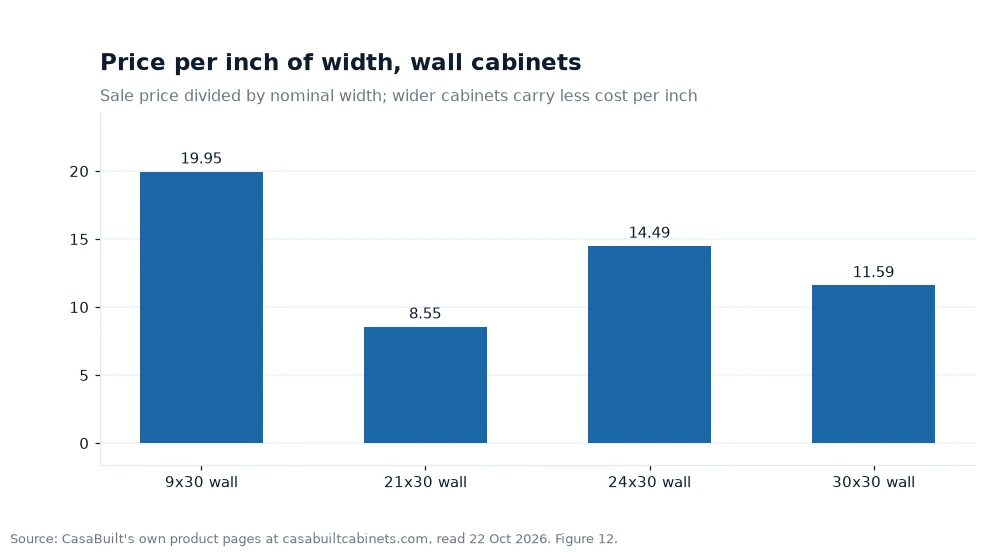
The chart prices 30-inch-high wall cabinets by inch of width. A single-door cabinet is $179.54 whether it is 9 inches wide or 21 inches wide, so the rate slides from $19.95 per inch at 9 inches to $8.55 per inch at 21 inches. That is the cheapest width per inch in the entire wall range, and it is also the width most small kitchens skip.
The double-door band starts at 24 inches at $347.76, which resets the rate to $14.49 per inch at 24 inches and brings it down to $11.59 at 30 inches. Wider still, and the same $347.76 covers 36 inches, or $9.66 per inch. Each step buys a wider cabinet without a wider price, but the jump at 24 inches means the cheap single-door widths deserve a second look before the run is drawn.
None of this is a reason to cram in narrow doors. A 9-inch wall cabinet beside a range looks like an afterthought. The point is narrower: in a small kitchen, the per-inch arithmetic and the visual rhythm should be checked together rather than assuming that wider is always better value. A free 3D design consultation is a reasonable place to test two width plans before ordering either.
| Width | Door type | Sale price | Price per inch | Where it earns its place |
|---|---|---|---|---|
| 9" | Single | $179.54 | $19.95 | Filler between a window reveal and a tall cabinet |
| 15" | Single | $179.54 | $11.97 | Short run above a small appliance garage |
| 21" | Single | $179.54 | $8.55 | Best rate in the wall range; pairs well in threes |
| 24" | Double | $347.76 | $14.49 | Narrowest double door; keeps a two-door look |
| 30" | Double | $347.76 | $11.59 | Standard above a 30-inch base |
| 36" | Double | $347.76 | $9.66 | Long wall with no window to break it |
Door swing is part of the layout
Every door in the range is full overlay, which means it covers the face frame and opens against the wall or against the next cabinet. CasaBuilt sells the line as rta cabinets with the hinge side set when the doors go on. In a narrow galley the swing matters more than the storage: two 24-inch doors opening toward each other at a corner collide, while the same two doors hinged away from each other do not.
The practical rule for a small room is to keep doors that open into the walkway as few and as narrow as possible, and to put the wider double doors on the wall where nobody stands. Where a corner is tight, a 9-inch or 12-inch base with a single door will open where a 30-inch double will not. That is a layout decision, not a product limitation, and it belongs on the plan before the order.
Height changes the same calculation. A 42-inch wall cabinet adds 12 inches of storage above the same footprint as a 30-inch one, but it also brings the top shelf to a height that shorter residents reach with a step. In a rental or a shared house, the 30-inch height is the easier compromise.
What a compact kitchen actually needs to store
Small kitchens are not short of volume so much as short of accessible volume. A base cabinet 30 inches wide with a half-depth back shelf stores less than its envelope suggests. Plan by zone instead: the sink base takes cleaning supplies, the drawer stack beside the range takes pans, and the wall cabinets take plates and dry goods. A run of three 21-inch wall cabinets gives three doors, three zones and no shared door, which is why the arithmetic below is not as odd as it looks.
Worked example: two ways to fill the same wall
Take a wall run of 63 inches between a window and a tall cabinet. Option one is three 21-inch single-door wall cabinets, which fill it exactly. Option two is two 30-inch double-door cabinets, which cover 60 inches and leave a 3-inch filler at one end. The chart gives the rate for each width: $11.59 per inch at 30 inches and $8.55 per inch at 21 inches.
Check the chart figures against the published prices. The 30-inch rate is $347.76 divided by 30, which is $11.592 and rounds to $11.59. The 21-inch rate is $179.54 divided by 21, which is $8.5495 and rounds to $8.55. The 9-inch and 24-inch bars follow the same method: $179.54 divided by 9 gives $19.95, and $347.76 divided by 24 gives $14.49.
Now cost the two layouts. Two 30-inch cabinets are 2 x $347.76, or $695.52. Three 21-inch cabinets are 3 x $179.54, or $538.62. The three-door plan costs $156.90 less, covers 3 inches more and offers one more opening door.
Volume closes the argument. A 30-inch-high wall cabinet is 12 inches deep, so its envelope is width x 30 x 12, divided by 1,728. At 30 inches that is 10,800 cubic inches, or 6.25 cubic feet, and two of them hold 12.5 cubic feet. At 21 inches it is 7,560 cubic inches, or 4.375 cubic feet, and three of them hold 13.125 cubic feet. The cheaper plan holds slightly more volume as well: $41.04 per cubic foot against $55.64 for the wider pair.
Frequently asked questions
Which wall cabinet height suits a small kitchen?
It depends on the ceiling and on who reaches the top shelf. The range offers 30, 36 and 42 inch heights at 12 inches deep, and the taller cabinet adds storage without adding floor space. In a shared or rental kitchen the 30-inch height is usually the kinder choice, because the top shelf stays within reach.
Can I mix widths along one wall run?
Yes, and in a compact room you usually should. The widths are published as a fixed ladder from 9 to 39 inches for wall cabinets and 9 to 42 inches for bases, so a run can be built to the measured length without a filler panel. Keep the door tops aligned and the hinges consistent, and a mixed run reads as deliberate.
Do wall cabinets have to match the base widths?
No. Alignment matters more than matching. The eye follows the vertical lines where a wall cabinet edge sits over a base cabinet edge, so a 30-inch wall cabinet over a 30-inch base looks settled, while the same cabinet offset by 3 inches looks like a mistake. Where the widths cannot align, align the ends of the run instead.
Draw the run at two widths before ordering
Sketch the run both ways and stand in the room with the sketch. Three doors on a narrow wall feel busier than two, and the $156.90 saving only matters if the busier wall is acceptable in the room it is going into.
Then check the base run against the same logic, because the base ladder is longer and the flat price band from 30 to 42 inches changes the arithmetic again.
Figures quoted here come from the manufacturer's own website, read 22 Oct 2026[1.