Expanding From a Nano Setup to a Commercial Plant
Growth in brewing rarely arrives as one leap; it arrives as a sequence of published size tiers. The first kit is often a nano set of 5 BBL or less, the second step lands in the 1,000 to 3,000 litre micro craft band, and the third is a commercial plant measured in hectolitres. Knowing what each tier asks of the building is what keeps the expansion affordable.
Key takeaways
- HGMC publishes three working tiers: nano at 5 BBL or less, micro craft from 1,000 to 3,000 litres, and large commercial equipment up to 100 HL.
- The micro craft band is described as suitable for breweries producing 18,000 barrels or less in a year.
- A 5 BBL batch is about 585 litres, so moving to a 10 BBL batch roughly doubles the volume of a single brew, not the whole plant.
- Extra vessels, a boiler and packaging capacity usually cost more than the brewhouse itself, whatever tier you are buying.
The three published tiers, and what sits in each
The smallest published tier is the nano brewery, described as 5 BBL or less and noted for taking very little space. It is the shape most taproom projects start with: a compact brewhouse, one or two small fermenters, and packaging done by hand or by keg.
The middle tier is the micro craft brewery, published at 1,000 to 3,000 litres of batch size and described as capable of producing 18,000 barrels or less a year. Equipment in this band can sit in a restaurant, a commercial unit or an industrial building, which is exactly why it is the usual second step.
The top tier covers large commercial equipment up to 100 HL, with the published range of popular systems running from 5 BBL to 20 BBL and from 20 T to 50 T. The published capacity span across the whole catalogue is 100 litres to 200 tonnes, and equipment is offered from 1 BBL to 100 BBL, so the tiers overlap enough that a growing brewery rarely has to change supplier.
What has to change when you move up a tier
Volume is the visible change; utilities are the expensive one. A larger brewhouse needs more heating capacity, which usually means a steam system rather than a direct-fired kettle, and a steam system needs a boiler room, a feed water arrangement and a gas or electrical supply sized for it. HGMC publishes electric, steam and gas heating, so the choice can follow the building rather than the other way round.
Cooling is the next constraint. More fermentation volume needs a bigger glycol system and more jacket circuits, so the chiller and the cold room compete for the same plant space. Then come the drains, the water supply and the wastewater load, all of which grow with the batch size rather than with the tank count.
Control is the quiet change. A small kit can be run with a simple panel, while a commercial plant is far easier to operate with a PLC semi-automatic touch screen or a fully automatic control panel with curve indication and production-record printing. Moving up a tier is a good moment to move up a control level at the same time, because retrofitting automation into a working brewery costs more than ordering it with the vessels.
Keeping the first kit useful
The nano set does not have to become scrap when the commercial plant arrives. It can serve as a pilot system for recipe development, a taproom attraction, or a way to produce small seasonal runs without interrupting the main production schedule. Breweries that keep it in use usually report that the recipe pipeline moves faster, simply because trials no longer occupy a production vessel.
Layout is what makes that possible. If the expansion is planned while the nano kit is still the only equipment on the floor, the second tier can be built around it rather than on top of it. That is where the free 2D, 2.5D and 3D design service matters: brewery space layout and brewhouse vessel and piping design are offered as 3D models, so an expansion can be drawn before it is bought.
| Tier | Published capacity | Typical next step | Main change |
|---|---|---|---|
| Nano | 5 BBL or less | Add fermenters, then a second brewhouse | Packaging moves off manual labour |
| Micro craft | 1,000 to 3,000 litres | Longer brew days or a third vessel | Steam, glycol capacity and drainage |
| Small commercial | 5 BBL to 20 BBL systems | Automation and a canning or bottling line | Labour and utilities rather than steel |
| Large commercial | Equipment up to 100 HL | Full plant automation and recovery systems | Site, services and building works |
What the step costs, as published
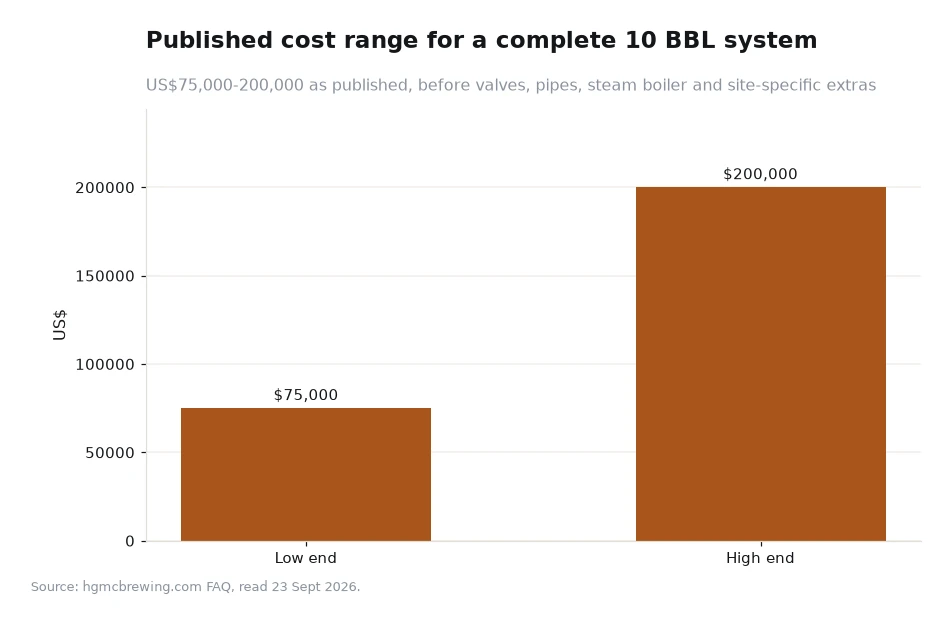
The manufacturer publishes one capital reference for a complete 10 BBL beer equipment system: around US$75,000 to US$200,000, before valves, pipes, a steam boiler and other site-specific requirements. Treated as a band rather than a quotation, that figure is the anchor for the whole expansion conversation, because the 10 BBL system sits squarely between the nano tier and a large commercial plant.
Worked example: the volume jump from a nano kit to a commercial batch
Assumptions: 1 BBL equals about 117 litres, a nano batch of 5 BBL, a commercial batch of 10 BBL, eight brews a month on the nano kit and twelve brews a month on the larger plant. The nano batch is 5 multiplied by 117, which is 585 litres. Eight brews a month gives 4,680 litres a month, or 56,160 litres over a year.
The 10 BBL batch is 10 multiplied by 117, which is 1,170 litres. Twelve brews a month gives 14,040 litres a month, or 168,480 litres over a year. In other words the commercial plant produces three times the monthly volume and three times the annual volume of the nano kit, with the same number of brewing days per week if the cycle allows.
Now apply the published capital band to that output. US$75,000 spread over 168,480 litres in the first year is about US$0.45 per litre; US$200,000 spread over the same volume is about US$1.19 per litre. The gap, US$125,000, is exactly the valve, pipe, boiler and site-work allowance the manufacturer warns about, and on this arithmetic it is also the difference between a plant that pays back in litres and one that waits.
Frequently asked questions
Can I reuse my nano fermenters on a larger brewhouse?
They can still be used for trials and seasonals, but they will not absorb a 10 BBL batch, and mixing small and large vessels in one production plan complicates scheduling. Most breweries keep one or two small tanks for experiments and buy a matching set for production volumes.
How long should I plan for the step up to a commercial plant?
Published delivery is 90-150 days from deposit to door, and that window assumes the building is ready when the equipment arrives. Site works, utility upgrades and permits usually run in parallel and often take longer, so the building programme should start before the purchase order is signed.
Plan the second step before you take the first
Sketch the site as it would look with the next tier installed, even if that day is three years away. Reserve the wall length for additional fermenters, keep the boiler position clear of the cold room, and note where a larger chiller could go without blocking the delivery route.
When the numbers do justify the move, the published material makes the comparison straightforward: the micro craft brewery pages cover the 1,000 to 3,000 litre band and the larger plant pages describe equipment up to 100 HL. HGMC also offers installation, commissioning, operator training and spare parts supply, which matters most at the moment a plant doubles in size. If you want to see how hgmc brewing frames that progression, its service and design pages set out the sequence from layout drawing to first brew, and the after-sales desk stays available for the questions that only appear once the plant is running.
Figures in this article come from the manufacturer's own website, read 23 Sept 2026, including the published 5 BBL nano, 1,000 to 3,000 litre micro craft and 100 HL commercial tiers, the 10 BBL cost range, the 6-year warranty wording and the 90-150 day delivery window; the barrel-to-litre conversions and cost-per-litre figures are this article's own arithmetic with assumptions stated. Details: [1]