MR and BWR Grades: Choosing Glue for Interior Projects
Glue grade is one of the easiest decisions to get wrong and the slowest to show up, because a panel bonded for dry service fails as edge swelling rather than as a visible defect on delivery. The published classes run from E0 and E1 through MR and WBP to Phenolic Dynea, and the practical choice for interior work narrows to two of them. Get the exposure level right and a six-container programme behaves; get it wrong and the failure appears in the third winter of a shop fit.
Key takeaways
- MR (Moisture Resistant) suits dry interiors — office furniture, shelves, partitions away from water lines.
- BWR (Boiling Water Resistant) is the safer grade where humidity and light water exposure are routine, such as kitchen and bathroom units.
- Six glue classes are published: E0, E1, E2, MR, WBP and Phenolic Dynea, so a specification should name one rather than say "water resistant".
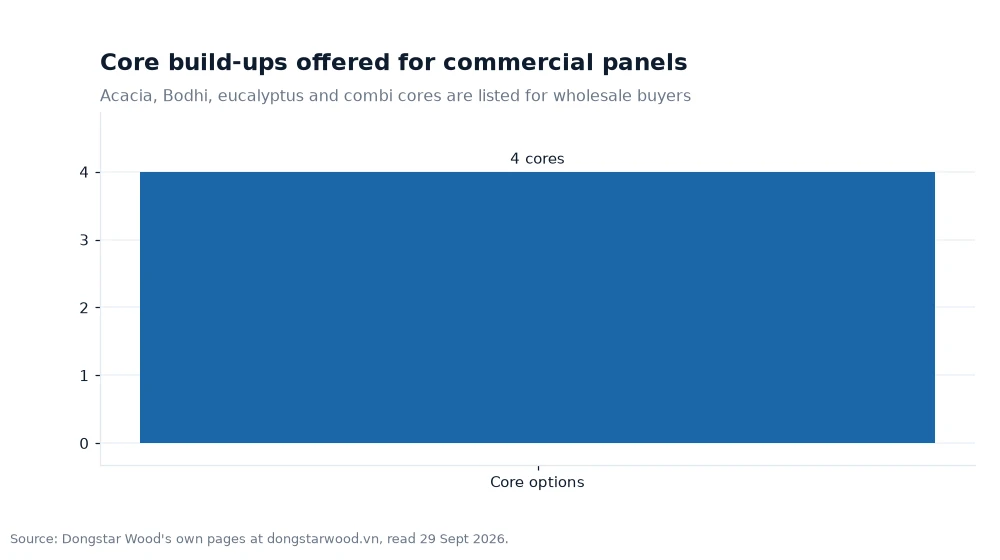
- Four core build-ups are offered — Acacia Core, Bodhi (white hardwood), Eucalyptus Core and Combi Core — and the core often decides performance more than the glue label.
What MR and BWR actually promise
Both grades are about moisture, and neither is about standing water. MR is built for dry service: furniture carcasses, drawer boxes, shelving and partition panels in heated interiors where humidity moves with the season but water never sits on the edge. BWR is the step up, aimed at humidity and light water exposure — the splash zone around a sink, a hotel bathroom vanity, a laundry unit, or a kitchen line that gets wiped down daily.
The distinction matters most at the cut edge, not on the face. A sealed panel face resists moisture almost regardless of grade; the unprotected edge is where adhesive performance is tested. That is also why edge sealing is written into most furniture specifications as a separate requirement from the glue class itself.
The core build-ups behind the grade
A mill can offer the same MR class across four different cores, and the four behave differently under load. Acacia Core is described as high-strength hardwood with strong load-bearing capacity. A white hardwood build-up — the Bodhi core — trades some of that strength for stability and cost-performance. Eucalyptus Core is the densest of the group and is specified for compression and bending. Combi Core blends eucalyptus with acacia, or hardwood with softwood, to balance strength against weight and cost.
The published range of possibilities, in short:
| Element | Published options | Typical interior use |
|---|---|---|
| Glue class | E0, E1, E2, MR, WBP, Phenolic Dynea | Dry service through to humid interiors |
| Core | Acacia, Bodhi, Eucalyptus, Combi | Load-bearing carcasses to cost-controlled shelving |
| Thickness | 6–9 mm, 12–15 mm, 18 mm | Cabinet backs, shelves, heavy-duty panels |
| Face veneer | Birch, Pine, Bleached Poplar, EV, Rose Eucalyptus | Paint, stain, laminate or clear finish |
Matching the grade to the room, not to the price sheet
Interior projects are rarely uniform, so the useful exercise is to walk the drawing and mark every panel that will ever meet water. Kitchen and bathroom units are the obvious candidates, but hotel corridors, restaurant tabletops and any panel sitting over a wet process belong on the same list. Everything else is a candidate for MR, which keeps the material cost structure simpler across a large order.
Contractors tend to standardise on 12 mm and 18 mm thicknesses because those two cover most of a furniture programme. Shelving, office furniture and hotel fixtures sit in the 12–15 mm band, while heavy-duty worktops and structural panels take the 18 mm sheet. Mixing grades across a standardised thickness is easier than mixing thicknesses, because cutting plans and panel optimisers stay untouched.
Where veneer quality sits in the decision
Glue decides how the panel survives moisture; the face decides how it looks after finishing. For interior joinery, cabinet doors and visible shelving, the face veneer carries the project — birch and bleached poplar finish well under paint, rose eucalyptus and EV run darker, and pine brings a warmer tone. A board that is correctly bonded but poorly faced will still be rejected on site, which is why face grade codes belong in the same purchase specification as the glue class.
This is where Commercial Plywood programmes differ from general panel trading: the same mill can press furniture plywood, hardwood plywood and veneer plywood to one specification, the exporter's published position for European buyers includes factory-direct pricing and No Anti-Dumping Tax status, which changes landed cost more than a small movement in the glue price ever will.
Worked example: area and cut yield on a 1,000-sheet order
Take a cabinet programme as an example. Take the 1220 × 2440 mm format first: 2.98 m² from 1.22 m × 2.44 m of panel per sheet. One thousand sheets is therefore 1,000 × 2.98 m² = 2,980 m² of board. If a wardrobe carcass consumes 2.4 m² of cut panel after trimming and waste, that order covers 2,980 ÷ 2.4 = 1,241 carcasses.
Now split the grade load. Suppose 30% of that programme is kitchen and bathroom work needing BWR and the rest is dry-service MR. A 1,000-sheet order becomes 300 sheets of BWR and 700 sheets of MR, which is a mix a mill can run across the same core and thickness rather than treating as two separate jobs. Both figures are examples derived from published sizes and arithmetic, not quotations.
Documentation that should travel with the panels
Two documents settle most grade disputes before they start: the technical sheet naming the glue class, and the packing list that ties the batch to the container. Ask for both with the proforma rather than with the complaint. On European programmes, add the emission paperwork — CARB P2 or CE documentation where the receiving market requires it — and keep the FSC and EUDR references in the order file so a customs question can be answered from the same folder.
If a supplier names a glue class but cannot say which core it is pressed with, treat the answer as incomplete. The core choice is published, it is not a trade secret, and a specification that fixes both is a specification a factory can actually run against.
Frequently asked questions
Can one panel grade cover a whole interior fit-out?
It can, if you accept the cost of over-specifying. Running BWR everywhere removes the risk of a wet-area panel slipping through, but it also pays the higher bond price on hundreds of sheets that never see water. Most programmes split the drawing into wet and dry zones instead.
Is MR suitable for a kitchen?
Only where the unit stays dry. Published guidance places MR in dry interiors and BWR in humidity and light water exposure, so a sink base, a dishwasher surround or a bathroom vanity belongs in BWR, while tall cupboards away from plumbing are comfortable in MR.
How do I check the glue class on a delivery?
Match the batch number on the packing list to the technical sheet, confirm the stated class against your purchase order, and check the panel edges for consistent bond line before the stack is stripped. Edge condition is the fastest visible indicator that the panels were pressed to the class you specified.
Setting the specification before the next enquiry
Write the glue class, the core, the thickness and the face veneer into one line per panel type, and send that line with the enquiry instead of a general description. Buyers who want to see the full spread of grades and thicknesses can start from the mill's home page, while projects with a birch face and a stricter machining tolerance are better checked against the birch line's own page before the drawing is frozen.
The grades, cores and sizes quoted above are taken from the manufacturer's own pages, which I read on 29 September 2026 as the source for this guide as the source for this guide for the data in this comparison[1].